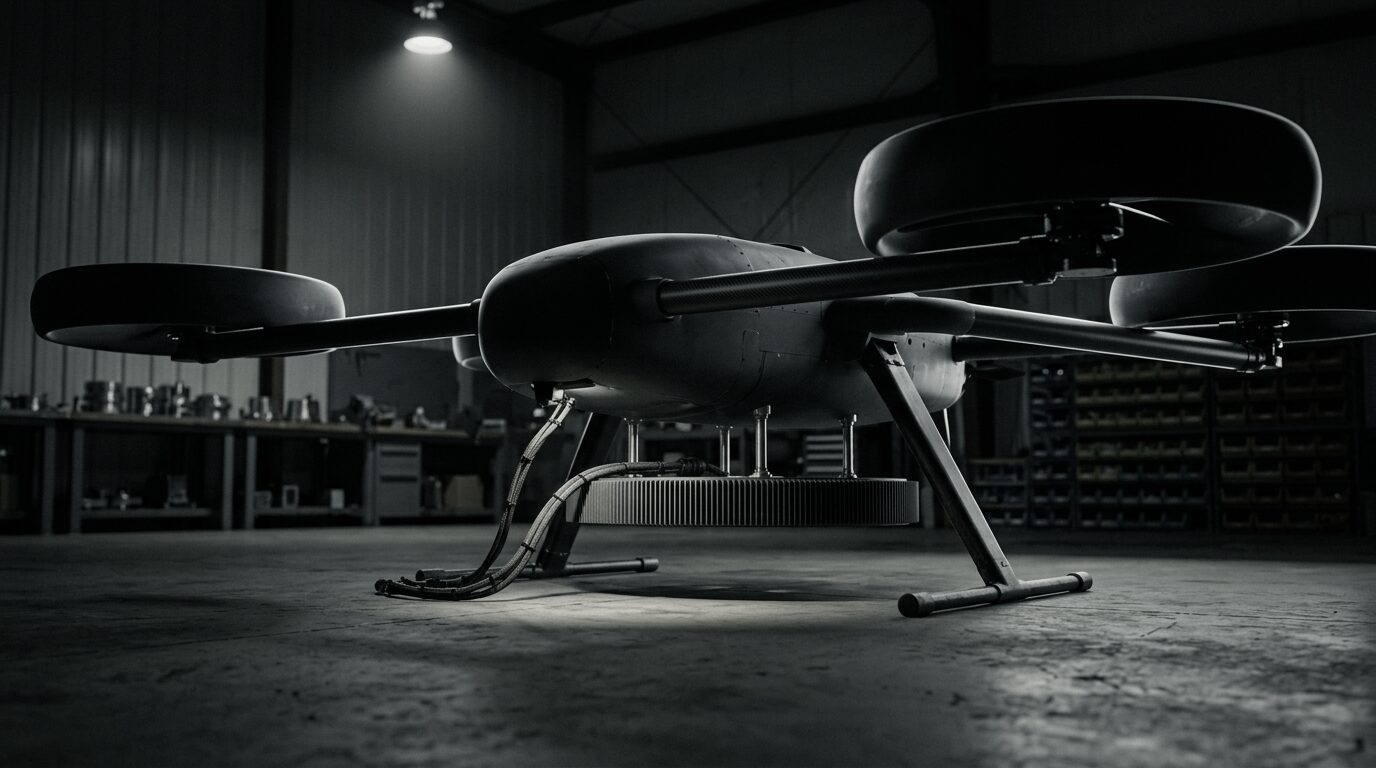
Drift™
Takes away up, and gives it back thirty seconds later.
Area vestibular denial · Concept
The inner ear can be written to from outside the body.
Inside each ear, beneath the semicircular canals, sit two small organs called the utricle and the saccule. A pad of crystals rests on a bed of hair cells. When your head tilts or accelerates the crystals lag, the hairs bend, and the nerve underneath changes its firing rate. That firing rate is your sense of which way is down. Nothing else supplies it, and the brain holds no second opinion to check it against.
Those organs are mechanical, and a mechanical sensor can be driven from outside. Air-conducted sound at 500 Hz, the frequency they are most sensitive to, moves them directly. This is not exotic and it is not theoretical. It is a routine clinical test: 500 Hz tone bursts at these levels are used every day to evoke a vestibular reflex and confirm the organ is working. Above about 128 decibels the response stops being merely measurable and becomes reliable.
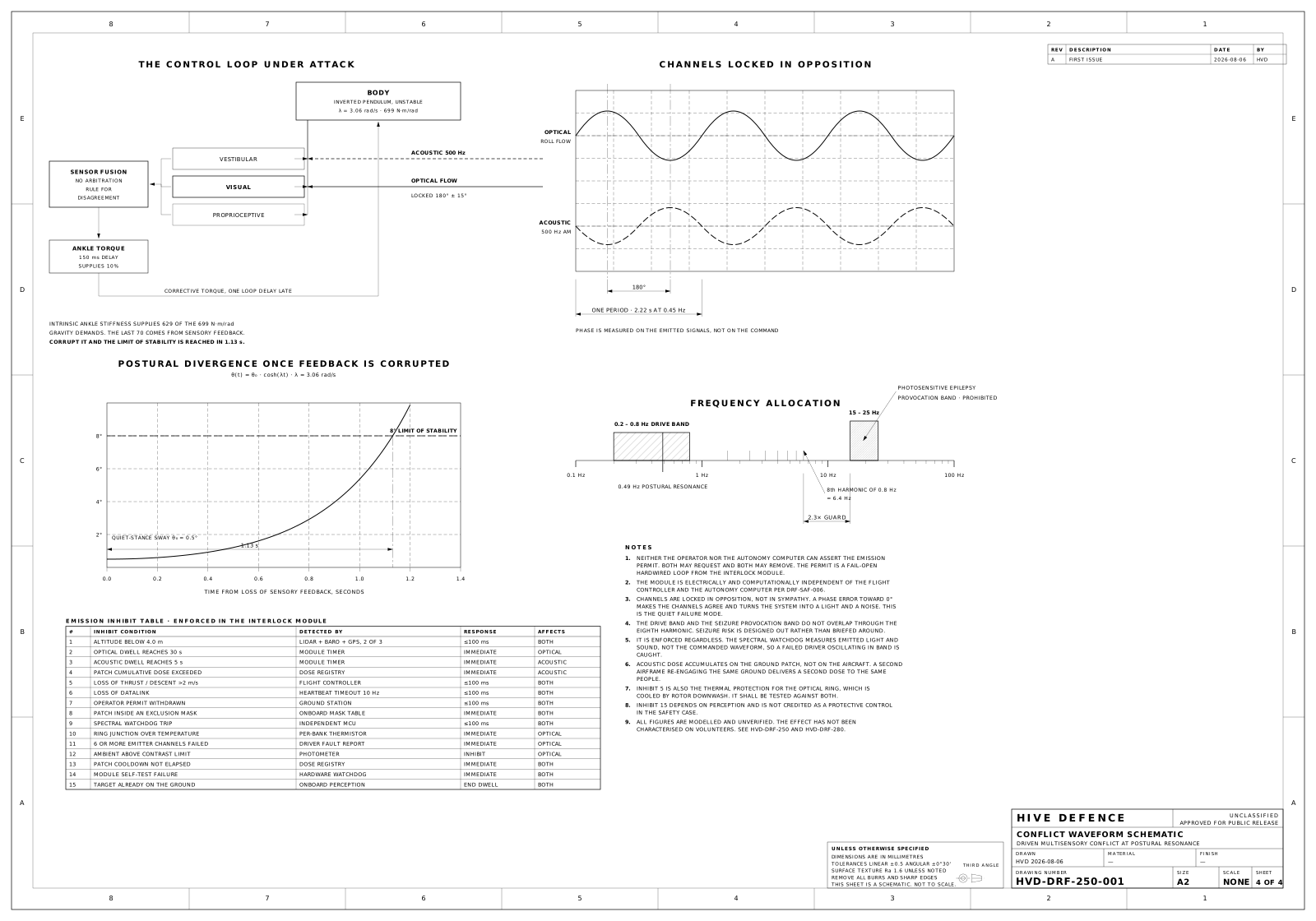
DRIFT sits at 128 decibels and not one decibel above it, modulated at 0.49 Hz, the natural frequency of standing. At the same moment it writes a contradicting motion onto the visual field, on the ground where a standing person is already looking. Two sensors, two answers, and no rule for deciding between them. They are not confused. Their instruments are lying to them.
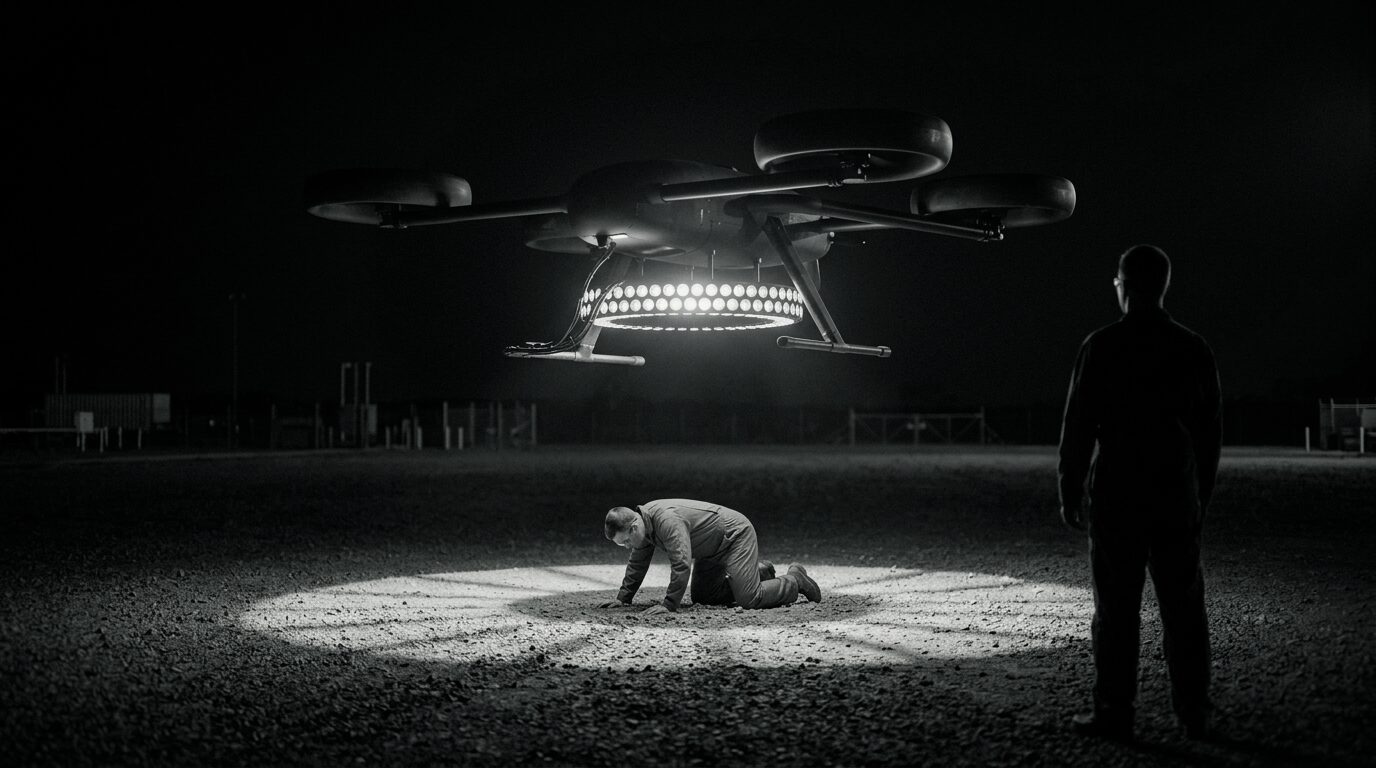
One aircraft holds five metres up and puts 763 square feet of ground inside that contradiction. Step off the edge and there is nothing to feel.
The physics is why it flies.
Two things fall away with range at once. Light falls as the inverse square, which is the cheap half. The expensive half is geometry: a flow field only drives posture if it fills a large part of the visual field, and a brilliantly lit circle seen from a hundred metres is a bright patch in the distance, not a flow field. Angular extent cannot be bought with watts.
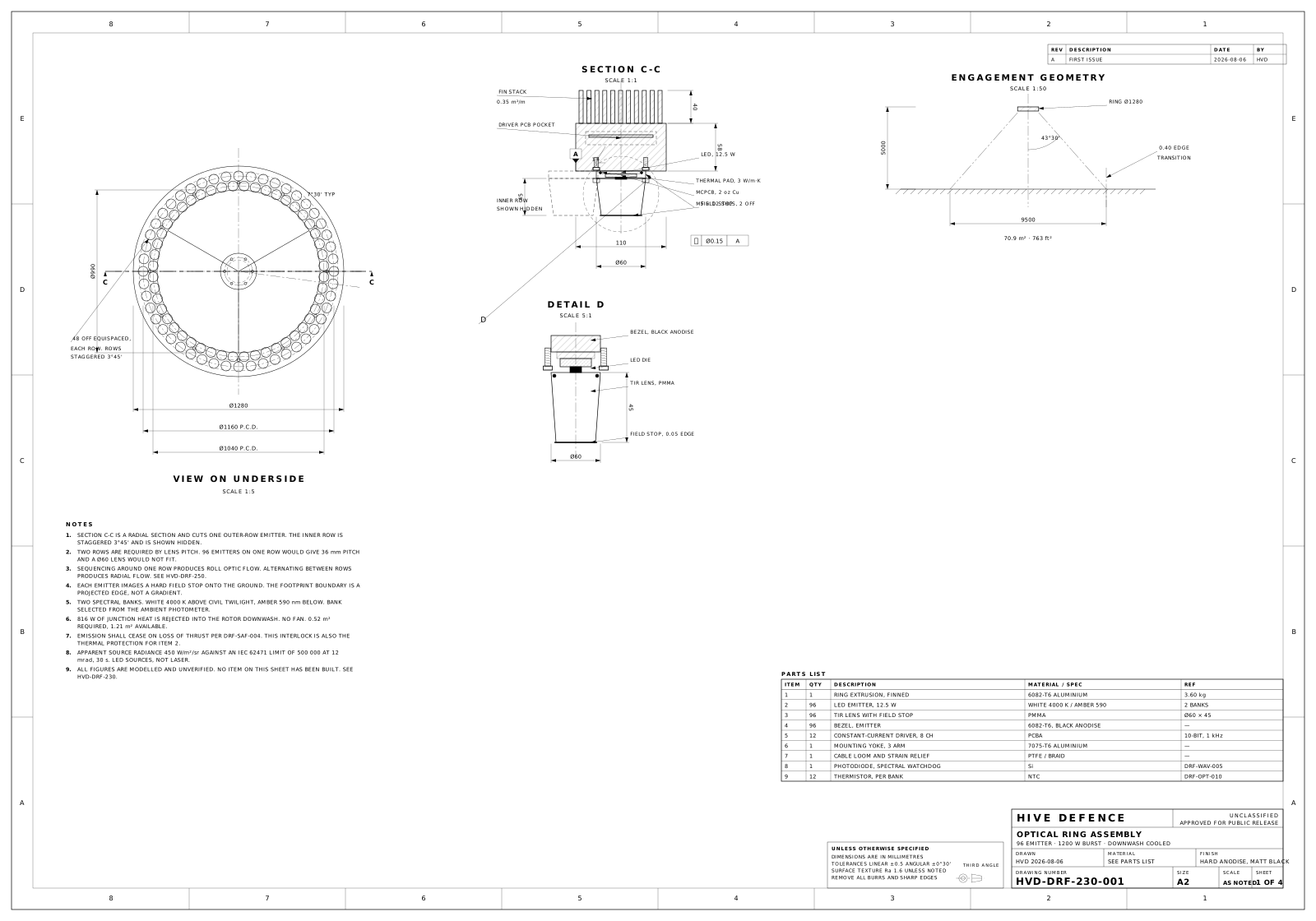
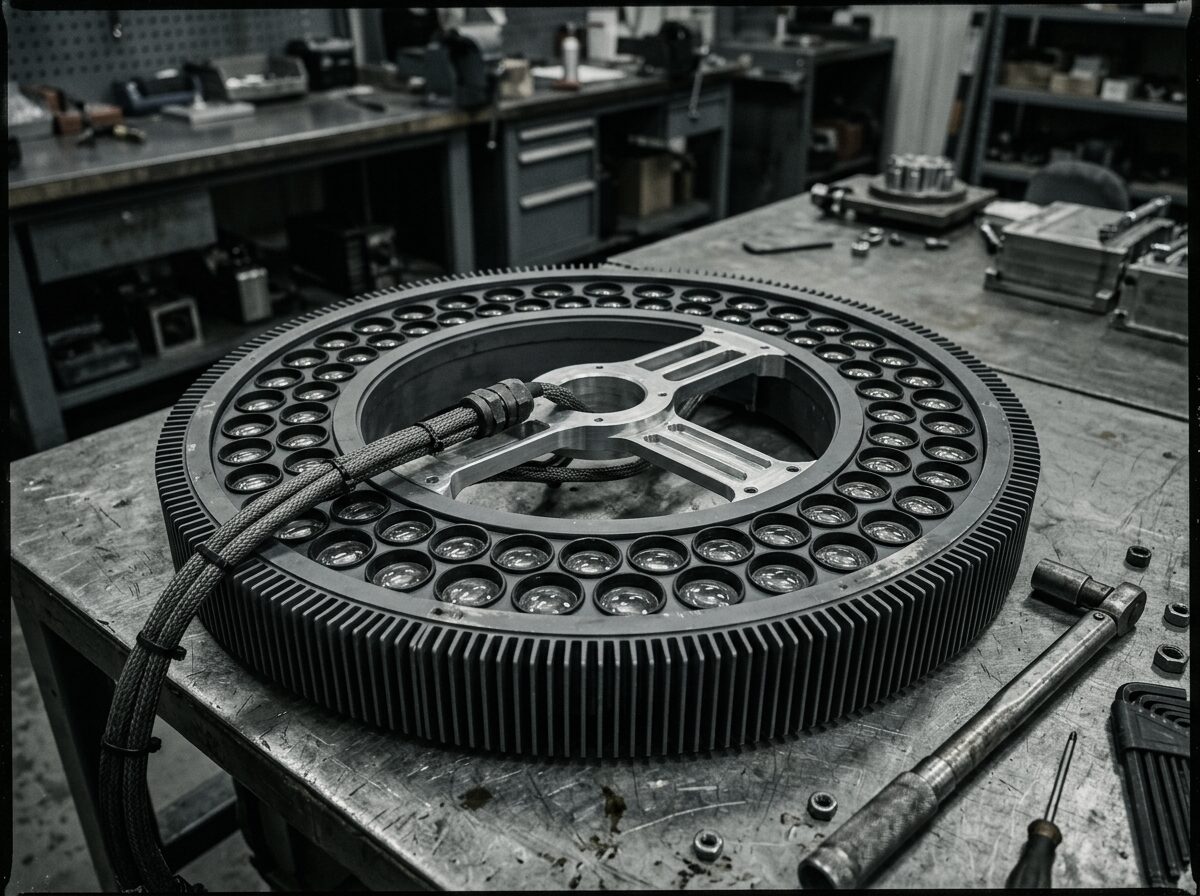
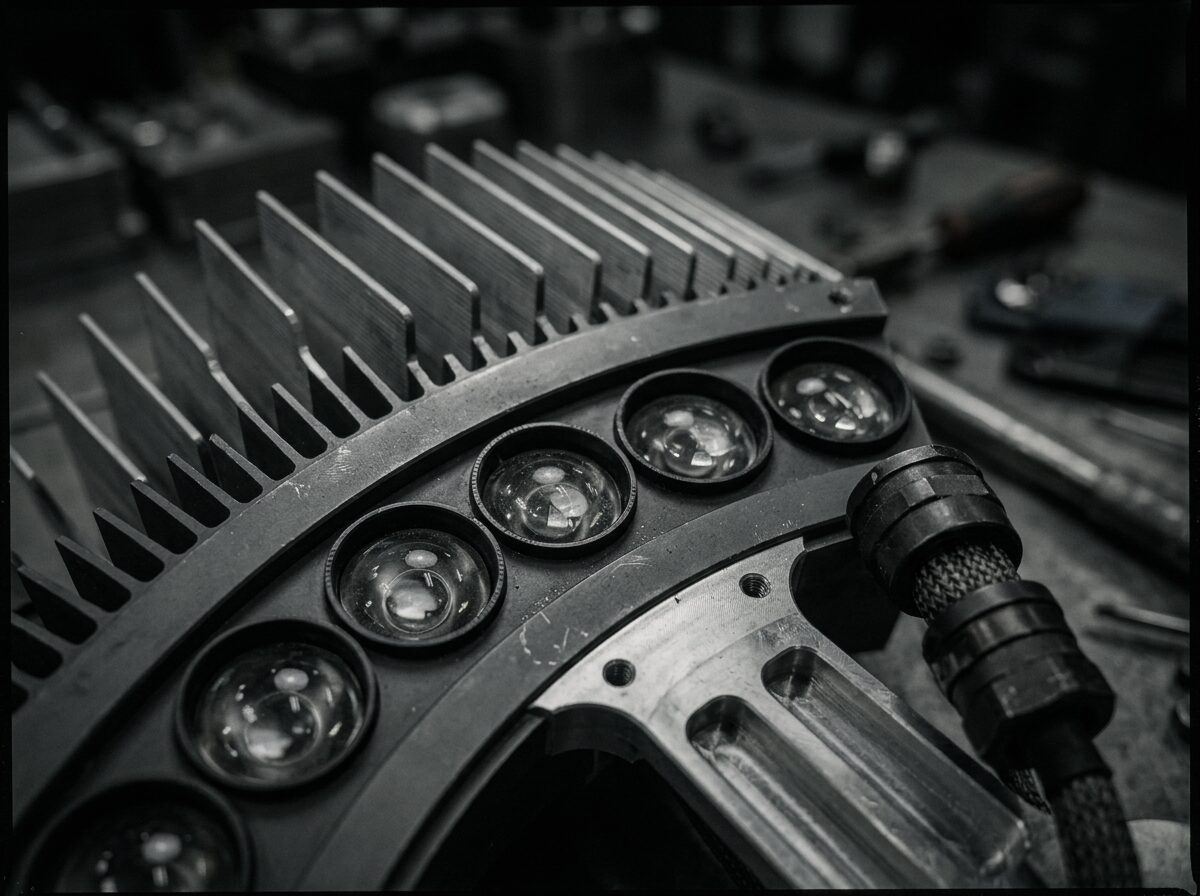
So DRIFT does not stand off. It closes. Each aircraft carries a 1.1 metre emitter ring holding 96 addressable emitters in two staggered rows, and holds a station box four to six metres above the ground. Nothing about that ring needs to be cold, and nothing about it needs to be exotic.
Being close is also what makes it eye-safe. Retinal hazard follows the radiance of the source, and no lens can raise radiance. A standoff dazzler has to concentrate its output into a near point and carries a real retinal risk. DRIFT emits the same power from a ring subtending 220 milliradians, landing three orders of magnitude below the thermal damage floor. The aircraft never reaches further. There are simply more of them.
Every other non-lethal is a noise jammer.
A dazzler saturates the retina. An acoustic hailing device swamps the cochlea. A heat ray overwhelms the nerve endings in your skin. Pepper spray floods the trigeminal. A conducted energy weapon overrides motor nerves. All five do the same thing: put more energy into a sensory organ than that organ can handle.
That has three consequences, and they are the reason this category has stalled. Capability is bought with power. Injury risk rises with the same power. And every one of them is beaten by simple attenuation, because if the attack is loudness then earplugs are the answer, and if it is brightness then sunglasses are.
DRIFT overwhelms nothing. It hands two senses clean, plausible, contradictory information and drives the controller that fuses them at the frequency where that controller is weakest. A hundred and twenty eight decibels is quieter than a fielded hailing device. The light sits three orders of magnitude below the threshold that could damage an eye. The effect comes from where in the loop it is injected, not from how hard.
So the arithmetic inverts. Effect is bought with timing and phase rather than with watts, which is why the injury risk stops rising with the capability. And attenuation stops working, because damping one channel does not settle a disagreement between two. It only changes the weighting on a decision that is still being handed two answers. The only complete defence is to remove both channels at once, and a man who is blind and deaf is already out of the fight.
Aircraft are assigned to ground, not to people.
A weapon that has to be pointed at an individual does not scale, and counting heads in a moving crowd is a losing game. So DRIFT does not count heads. Each airframe is handed a patch of ground and told to hold it. Whoever is standing on that patch is in the engagement, and whoever walks onto it joins.
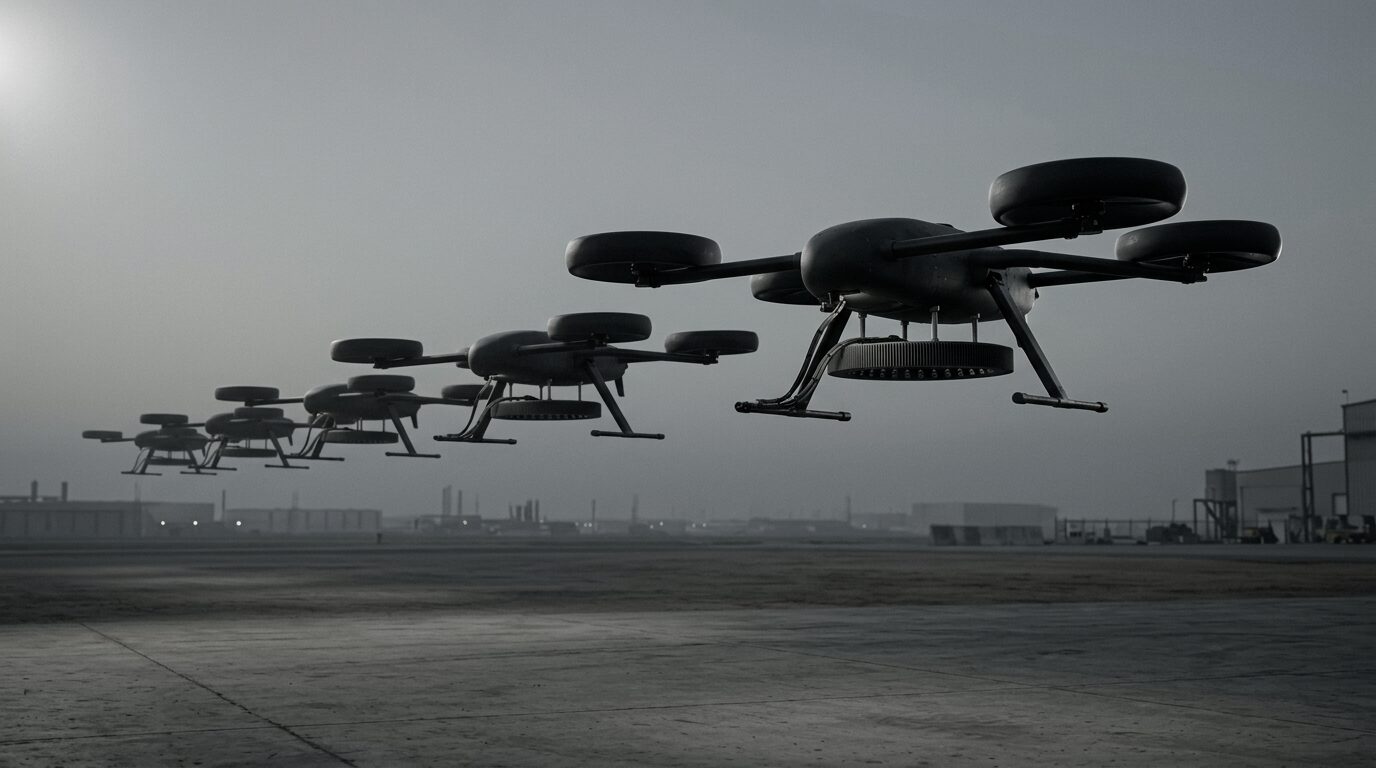
That turns area into arithmetic instead of physics. Forty-eight aircraft line abreast at nine metre spacing lay down four hundred and thirty metres of frontage. Walk that frontage forward at patrol pace and it clears a hectare every sixteen seconds. Two hundred and forty airframes sweep a square kilometre in five and a half minutes.
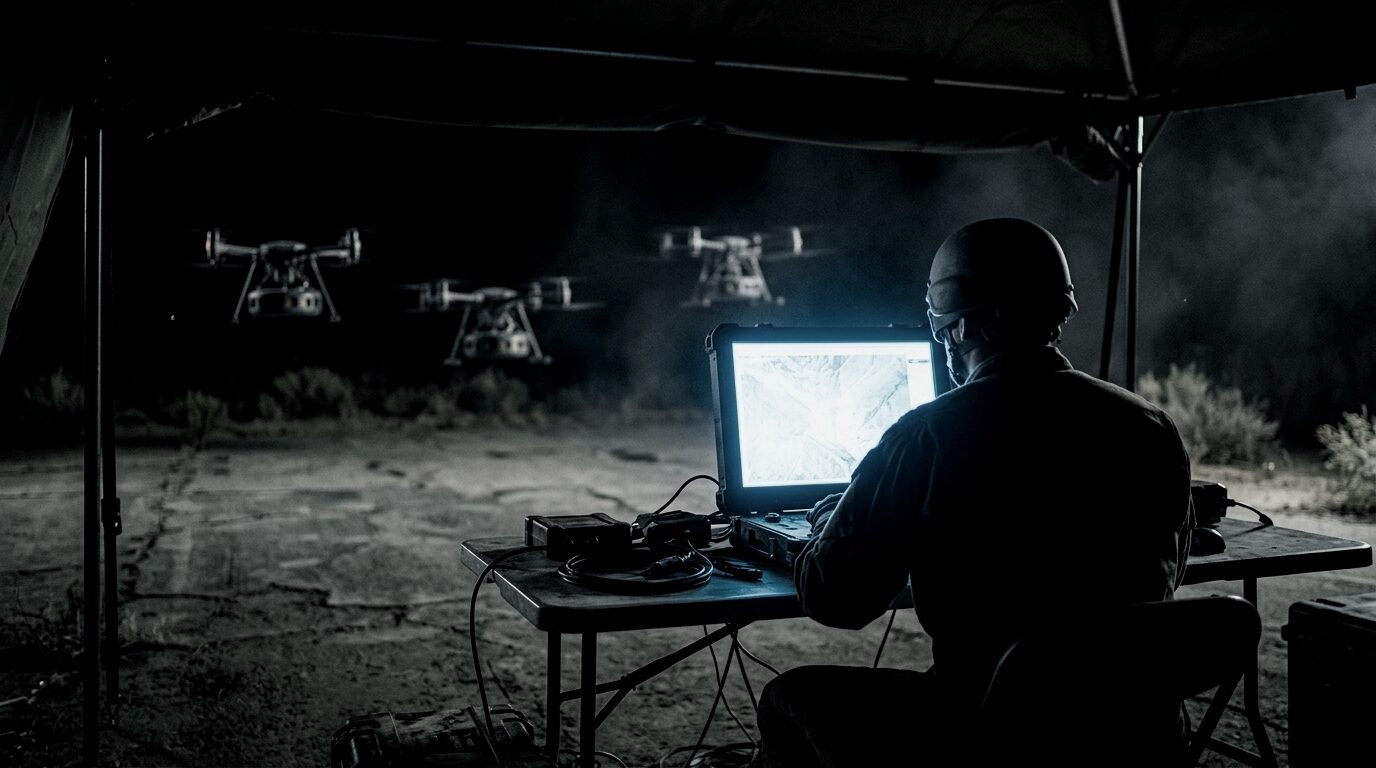
None of that needs a stronger emitter. It needs more aircraft, which is the cheap half of the system, and it still needs only one operator, because the assignment is a map and not a joystick.
How it works
Write to the nerve, not to the mind
DRIFT does not touch cognition and claims nothing about it. It drives the otolith organs of the inner ear directly with sound, upstream of any thought at all. The target does not become confused. The target becomes unable to stand up, aim, or walk a straight line.
Contradiction, not magnitude
The vestibular drive and the optical field are phase-locked in opposition, 180 degrees apart. Neither is strong enough alone. Together they put the two dominant inputs to the fusion in direct disagreement, which is the one condition the controller has no rule for.
Hold ground, not a person
Each airframe is handed a patch of ground off the shared map and told to keep it. Whoever is standing on it is in the engagement, whoever walks onto it joins, and nobody has to be identified, tracked or counted first.
Curtain, lid or point
Line the element abreast and walk it forward to clear ground. Park it as a static lattice to deny a square for as long as the batteries hold. Or send one aircraft to one doorway. Same airframe, three formations, one map.
Nobody hears it arrive
One metre toroidal rotors turning at 71 metres per second at the tip put the airframe at 54.6 decibels at five metres, which is roughly the ambient of the street it is standing over. Noise goes as the sixth power of tip speed, so that single number is what sizes the rotors and through them the whole aircraft. This is survivability, not theatre: an aircraft at five metres that announces itself gets netted, and the effect only holds while it is overhead.
Thirty seconds, then it is over
The field collapses when the aircraft climbs, when the link drops, when thrust is lost, or when the ceiling fires. Balance returns as fast as it left. Nothing to treat, nothing to evacuate, nothing to explain to a coroner.
Governed in hardware
Fifteen inhibit conditions live in a module with its own processor, its own supply and its own watchdog, and neither the operator nor the autonomy computer can assert the permit. Both can only ask, and both can always cancel. An operator cannot extend a dwell, and cannot hold a field on somebody who is already on the ground.
What Drift is not.
This category attracts people selling physics that does not exist. Here is the edge of ours.
Not a brainwave weapon
There is no such thing, and anyone offering you one is offering you nothing. DRIFT corrupts the sensory inputs to a balance controller and stops there.
Not a magnet
DRIFT was specified around magnetic vestibular stimulation. That effect is real and delivering it from an aircraft is not. Holding the threshold field across the footprint needs 1,629 clinical MRI magnets, a winding wider than the coil containing it, and an internal field of 9,978 tesla against a 1,200 tesla record. We publish the arithmetic rather than wait to be asked for it.
Not a standoff weapon
It will not reach 200 metres and it will not work through a vehicle roof. Both answers are the same answer. Angular extent cannot be bought with watts.
Not a daylight weapon
Projected contrast collapses above roughly 1,500 lux. DRIFT owns the dark and gives up the middle of the day. Sirocco covers daylight, and the split is deliberate.
Not demonstrated
Effects are modeled from published postural and vestibular literature. Nothing here has been run on a range against a person. We will keep saying so until it has.
Specification
Figures marked modeled are analytical design points subject to verification.
- Effect
- Induced postural instability
- Mechanism
- Acoustic vestibular drive · visual conflict
- Coupling
- Non-contact · sound and light only
- Optical channel
- 96 dual-die emitters · 1,200 W · modeled
- Vestibular channel
- 500 Hz at 128 dB · reliable capture
- Modulation
- 0.2 to 0.8 Hz · 0.49 Hz resonance
- Station height
- 4 to 6 m above ground · modeled
- Footprint
- 763 ft² per aircraft · modeled
- Edge transition
- 0.40 m · projected field stop
- Onset
- 1 to 3 s · modeled
- Dwell ceiling
- 30 s optical · 3 s acoustic · interlock
- Recovery
- Immediate on field collapse
- Light envelope
- 0 to 1,500 lux ambient · modeled
- Emitter
- 1.10 m ring · downwash cooled
- Eye safety
- IEC 62471 · 1,111× margin · modeled
- Rotors
- 4 × 1.05 m toroidal · 69.4 m/s tip
- Span
- 2.61 m diagonal · 2.15 m across flats
- Acoustic signature
- 54.0 dBA at 5 m · modeled
- Airframe
- Group 2 · 25.0 kg · 22 min · modeled
- Frontage
- 9 m per airframe, line abreast
- Sweep rate
- 1 hectare per 16.5 s on 48 · modeled
- Formation
- 8 to 240 airframes · one operator
- Assignment
- Ground patches from the shared map
- Interlocks
- 15 conditions · module, not console
- Compliance
- Designed to DoD Directive 3000.03E review
- Status
- Concept · modeled, not demonstrated
Engineering
Sheets are drawn to ISO 128 and dimensioned from the analysis, not from the artwork. Nothing on them is classified.
Ask us about Drift.
Program offices, primes and end users. A HIVE engineer replies personally, usually within one business day.
- Channel
- briefing@hive-defence.com
- Location
- Southern California
- Response
- One business day
- Handling
- Unclassified only